
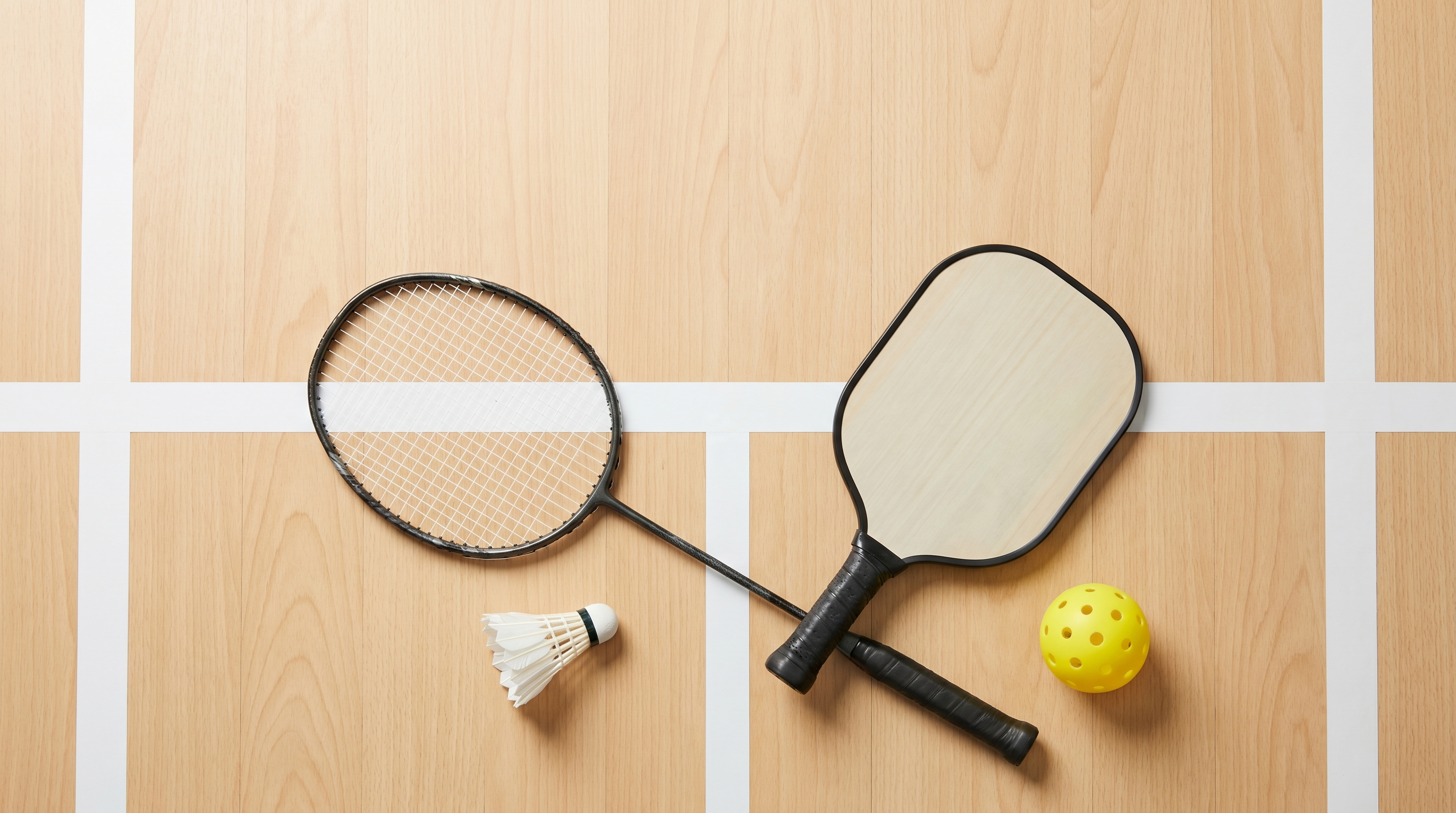
Hong Kong has more badminton players per capita than almost anywhere on earth. If that's you, congratulations, you've already paid for half the lessons you'd otherwise need in pickleball.
The court is similar. The pace at the kitchen line is similar. The hand-eye instinct, the wrist work, the soft touch, all transferable.
But pickleball isn't badminton, and the differences will trip you up if you don't adjust deliberately. Here's the conversion playbook for HK badminton players.
What transfers immediately
Five things badminton trained you to do well that work in pickleball from session one:
- Wrist control. Badminton's wrist-driven shots translate beautifully to pickleball dinks and resets. Soft hands at the kitchen feel natural to you.
- Quick reactions at the net. Badminton's net play has trained your reflexes for short, fast exchanges. Pickleball volley exchanges feel slow by comparison.
- Spin awareness. Badminton drops, slices, and clears all involve subtle spin. Pickleball spin is less extreme but the principle is identical.
- Court coverage on a small court. Badminton singles court is roughly the same footprint as a pickleball court. You're already used to the small-court geometry.
- Reading drop shots. Badminton drops are the closest analog to a pickleball third-shot drop. You'll pick up the spatial cue faster than tennis players will.
What to recalibrate
Two things badminton conditioned that don't quite work in pickleball.
1. The vertical game
Badminton is played up high, overheads, smashes, clears. Pickleball is played mostly low, dinks, drops, slow groundstrokes. Your instinct to rip a smash off a high feed will work occasionally, but not as often as in badminton.
Adjustment: resist the smash impulse. Pickleball balls don't accelerate the way shuttles do. A "smash" in pickleball is more like a pace-of-play put-away than a definite point-ender. Patience pays.
2. The non-bounce reflex
Badminton has no bounce. The shuttle is hit out of the air, always. Pickleball balls bounce, and the two-bounce rule explicitly requires a bounce on each side after the serve.
Tennis players adjust to the bounce naturally because they have one. Badminton players have to actively learn to wait for it.
Adjustment: let the ball bounce on serves and returns. Force yourself to stand back, wait for the bounce, and play the ball after it bounces. Your instinct to volley everything will give your opponents free points.
What pickleball actually rewards
Pickleball rewards three things badminton doesn't emphasize as heavily:
- Patient point construction. A typical pickleball point is 20-30 strikes; a badminton rally is 10-15. You need to settle in.
- Kitchen-line discipline. Badminton has a "no court area" near the net but it's narrower. Pickleball's 7-foot kitchen is much wider, and standing in it is a fault on volleys.
- Doubles partnership stacking. Pickleball doubles often involves both partners moving together, side by side, at the kitchen line. Badminton doubles uses front-back rotation. Same idea, different geometry.
The wrist trap
The biggest pickleball mistake I see badminton players make is over-wristing the dink.
In badminton, the wrist generates power and speed because the shuttle is so light. In pickleball, the ball is much heavier. A wristy dink shot tends to pop the ball up, giving your opponent an easy attack.
Adjustment: dink with a soft, locked wrist and a paddle face like a shelf. Your forearm and shoulder do the work, barely a millimetre of wrist. Visualize sliding a plate across a table, not flicking a frisbee.
Badminton-trained wrists need to actively quiet down for the first month of pickleball. Once you slow the wrist, your dink consistency jumps.
The right paddle for a badminton player
Badminton players gravitate toward control-spin paddles instinctively, and the instinct is correct.
The two paddles I'd point a badminton convert toward in HK:
- CRBN TruFoam Barrage if budget allows. The foam-core dwell time and pocketing feel suit the soft-hands instinct exactly.
- Vatic Pro V7 if budget is tight. Best price-to-performance in HK for a control-spin paddle.
Avoid power-first paddles like the Gearbox CX 14, they'll fight your wrist and amplify the over-wristing trap.
Take the paddle finder quiz for a personalized match.
Drills tuned for the badminton convert
Three drills that target the specific badminton-to-pickleball gaps:
- Patience dinking, 100 reps. Stand at the kitchen line. Cross-court dinks, slow pace, both forehand and backhand. Goal: not to win, but to keep the rally going past 30 strikes. Your wrist will thank you.
- Bounce-or-volley decision drill. Partner feeds balls at varied paces. Your job: decide bounce vs. volley each time, and only volley balls that are above your shoulders. Trains the patience to let pickleball bounces happen.
- Third-shot drop. From baseline, arc the ball over the net into the opponent's kitchen. This is the most badminton-like shot in pickleball, soft, lifted, controlled. You'll learn it faster than tennis players.
Spend 30% of session time on these three drills for the first month.
The mental shift
The hardest mental shift for HK badminton players is slowing down. Badminton's pace at the high level is some of the fastest in any sport. Pickleball is, by comparison, calm.
If you find yourself frustrated by how slow rallies feel, you're playing the wrong way. Lean into the slowness. Use it. Pickleball at its highest level is more chess than karate.
The patience you develop will also make you a better badminton player when you go back. The conversion runs both ways.
See you on court, and at the kitchen line.
Read common beginner mistakes next.