
Pickleball has dozens of rules. About 8 of them actually matter for your first month of play. The rest you'll absorb by playing.
This is the working set. Read once, play forever.
1. The court
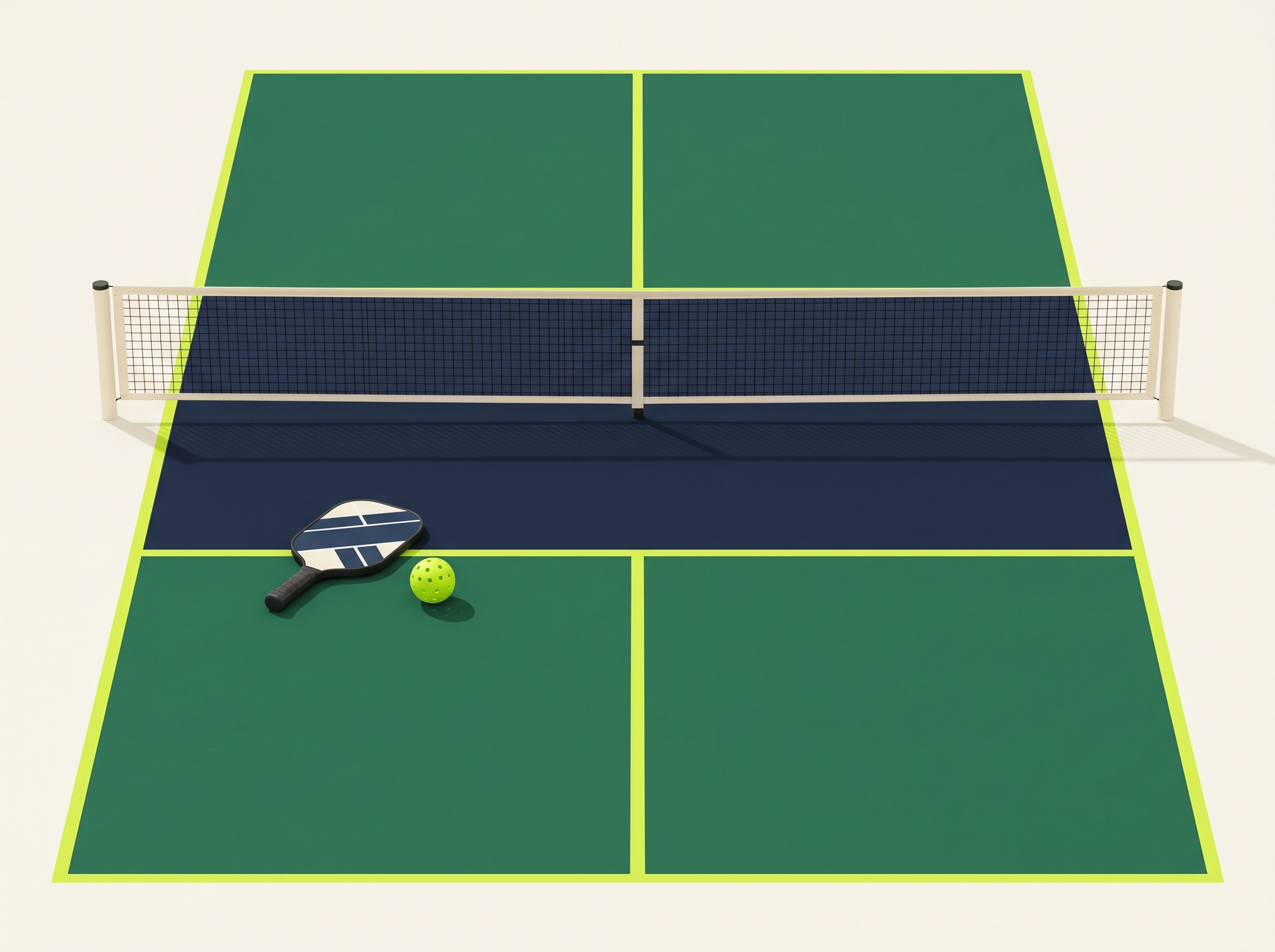
A pickleball court is 20 feet wide by 44 feet long, roughly the size of a badminton court. The net is 36 inches high at the posts, dipping to 34 inches in the middle.
Each side is split into two service boxes (right and left), and a 7-foot zone at the front of the net called the kitchen. We'll come back to the kitchen, because it's the rule beginners break the most.
2. Serving
The serve is unlike tennis. You serve underhand, with the paddle below your wrist at contact, and the ball must be struck below your waist. Most rule sets allow either a "drop serve" (you bounce the ball and hit it after the bounce) or a traditional underhand serve from the air.
You serve diagonally to the opposite service box. The serve must clear the kitchen, if it lands in the kitchen, it's a fault.
In doubles, the serving team announces the three-number call before each serve. We covered that in the scoring guide.
3. The two-bounce rule
This is the rule that makes pickleball work as a sport.
The serve must bounce on the receiver's side before being returned. The return shot must also bounce on the server's side before being played.
After those two mandatory bounces, anyone can volley (hit out of the air) from anywhere outside the kitchen.
The two-bounce rule slows the game down enough that beginners can rally. Without it, anyone with reasonable reflexes could end every point with a serve-and-volley.
4. The kitchen (no-volley zone)
The 7-foot zone in front of the net is the non-volley zone, universally called the kitchen.
You cannot hit a volley while standing in the kitchen, or while any part of your body, paddle, or even momentum is touching the kitchen line. If you volley, then your follow-through carries you into the kitchen, that's a fault.
You can stand in the kitchen all you want, you just can't volley from there. Beginners typically learn this rule after stepping in to volley a high ball and getting a "fault" called.
The simple version: let the ball bounce if you're at the kitchen line.
5. Faults
A fault ends the rally. The serving team loses the serve; the receiving team gains nothing (because of side-out scoring). Common faults:
- The ball goes out of bounds
- The ball hits the net and doesn't clear
- The ball bounces twice on your side
- You volley from the kitchen
- The serve lands in the kitchen
- Your serve hits the net (in most rule sets, though "net cord" serves were made legal in 2021 in major leagues)
If you're unsure who's at fault, the polite default is to call it on yourself. Pickleball has a strong honor culture.
6. Line calls
The line is in. If a ball lands on any part of the line, it's good. Easy.
Out balls: when in doubt, call it in. Beginners over-call out balls because they want the point. Don't. The community will respect you faster if you under-call than over-call.
7. Doubles partner positioning
In doubles, your partner stands in the diagonally opposite service box during the serve. After the serve and return, both teams typically rush forward to the kitchen line, because controlling the kitchen line is how doubles points are usually won.
Beginner pattern: serve from the baseline, return from the baseline, then both players move up to the kitchen line as a unit. Stay there until the rally ends.
8. The serve rotation
In doubles, both players on a team get to serve in a single rotation, except at the start of the game when only the second server (team A's "server #2") serves until the first side-out.
After the first side-out:
- Team A loses the serve. Team B's first server (B1) starts.
- B1 serves until their team loses a rally, now B2 serves.
- B2 serves until they lose a rally, that's a side-out, and Team A's first server (A1) starts.
- And so on.
This sounds complicated. Once you've played one game, it's intuitive.
What's not on this list
A few things beginners ask about that you can ignore for the first month:
- Lets (a ball that hits the net cord on a serve and lands legal). Different leagues handle these differently. In casual play, replay the serve.
- Service let interpretations. Same as above.
- The double-bounce rule's exact wording. Just remember: serve must bounce, return must bounce, then go.
- Paddle face inspection rules. These matter in tournaments, not your Tuesday open play.
When in doubt, ask. Pickleball culture is friendly to questions. People expect you to learn on the court.
One heads-up if you're playing in HK
The scoring system isn't always the global default. Lots of local open play uses rally scoring to 15 rather than side-out to 11, because most HK players grew up on badminton. Before your first point, ask which format the group is using. The full explanation is in the scoring guide.
Putting it together
For your first session, focus on three things:
- Serve underhand, diagonally, into the right service box.
- Let the serve and return both bounce, no rushing forward to volley early.
- Don't volley from inside the kitchen.
Everything else, you'll pick up by playing. See you on court.
Read your first-session checklist next, or browse HK courts that rent paddles.