
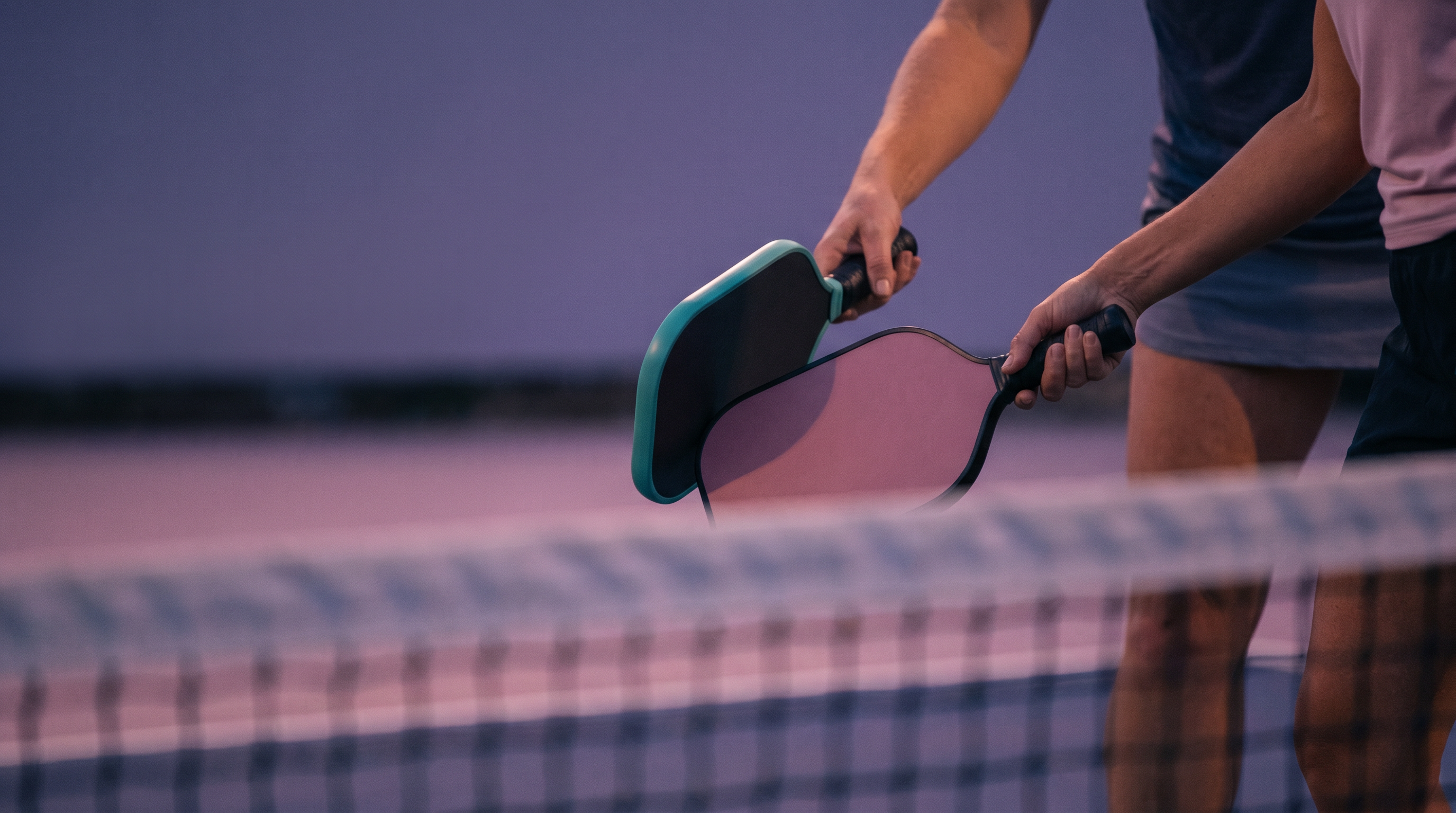
There's no rulebook for pickleball etiquette. There's just a thousand small ways to mark yourself as new, and one hour of reading saves you a year of figuring it out the hard way.
This is the unwritten version, written down. Half of these come straight from HK courts; the other half from talking with players and coaches who see the same beginner mistakes show up over and over. Read once. Refer back when something feels off.
Open-play basics
1. Paddle stacking is how rotation works
You walk into open play. There's a fence with paddles leaning against it. That's the queue.
You add your paddle to the back of the line. When it reaches the front, you're up. Don't skip the line, don't move your paddle, and don't ask to "play with my friend who's already on", you wait.
Most HK beginner-friendly courts use a simple paddle-stack system. Some use a clipboard or whiteboard instead. Same rule: there is a queue, and you're at the back of it.
2. Off-court between games
Once you finish a game (typically to 11, win-by-2), winners stay or rotate depending on the court's house rule. Either way, losers walk off and re-queue. Don't camp the court for "one more." Other people are waiting.
If a court runs "winners stay" and you've won three in a row, voluntarily step off. It's the unwritten rule that separates regulars from court-hogs.
3. Don't take more than four people on a court
Pickleball is doubles. A court fits four. If you and three friends want to "all play together as one group of six," you're using two courts in turns, not one court with substitutions. Treating it otherwise jams the rotation.
4. Joining a game already in progress
You don't. The point ends when it ends; you wait until the game finishes. Then you queue up for the next slot like everyone else.
If a foursome on a court is short a player and needs a fourth, they'll ask. Don't volunteer yourself onto a court mid-game.
5. The "got next" gesture
If you've been at the front of the queue for a while and a court is finishing up, it's polite to walk over and say "we've got next" rather than waiting silently. Avoids confusion. Doesn't speed anything up, but signals you know how this works.
At the kitchen line
6. Don't blast at people. Especially their face.
You're allowed to hit hard. You're not allowed to be a jerk. There's a wide gulf between a flat drive at the body (legitimate strategy) and a smash at someone's head from three feet away (just rude).
Beginners feel the difference instantly. So do regulars. So do parents. Pick the legitimate version.
7. Body-bagging is fine. Face-bagging isn't.
"Body bag" means hitting hard at the opponent's torso when they're at the kitchen, a real, legitimate tactic. The face is a different matter, especially with no eye protection. If you crack someone in the face and didn't try to, apologize immediately, it happens.
If you targeted the face on purpose? That's a different game. You'll find yourself queueing alone next week.
8. Eye protection is not weakness
Most HK regulars wear it. Most beginners don't. Most pickleball eye injuries are from your partner's deflection, not your opponent's smash.
The Z87 hardware-store version is HK$200. CRBN Drift glasses run HK$400-600. Either is fine. Don't be the person who skipped it because it "looks dorky", you'll look much dorkier explaining the eye patch.
9. Don't reach over the net
Even on a slammed-down ball at the kitchen, you can't reach over the net to "finish it." It's a fault. More importantly, even when you can technically do it, regulars consider it bad form for friendly play. Let the ball cross or let it die on the kitchen line.
10. Call the kitchen on yourself
You stepped on the kitchen line during a volley? You faulted. Call it. Even if no one else saw.
This is the single biggest signal that separates a regular from a beginner. Beginners look around to see if they got caught. Regulars announce it themselves. Be the second one. People want to play with you again.
Skill mismatches
11. Don't ask to play with the strong group
If a court of clear 4.0+ players is running, don't queue your name in. They want to play with each other. Find a court that matches your level, most HK venues run beginner-only sessions for exactly this reason.
If you're 3.0 and they're 4.5, you're not having fun and they're not either. That's a lose-lose.
12. If you're a 4.0 in a 3.0 game, soften your shots
You ended up on a beginner court because the venue was full. Fine. Don't dominate. Soften your shots, target the middle, give the beginners rallies, not winners. They'll thank you. The regulars watching will too.
This is the hardest etiquette for tennis converts to absorb. In tennis, you play your best. In pickleball rec play, you play to the level of the court.
13. Don't pick on the weak partner
In tournament play, targeting the weaker opponent is strategy. In rec play, it's rude. If your opponent's partner is clearly the worse player, hit a few balls to them, but don't make every shot a target on their forehead.
The exception: if both teams have asked for tournament-style play. Then anything goes.
14. Don't give unsolicited coaching
The single most disliked behavior in pickleball, across every court and every coach we've talked to. Don't. Even if you're right. Even if you mean well. Even if they "really should know that the kitchen rule applies during volleys."
If they ask for advice, give it. If they don't, shut up and play. The most universal pet peeve in the sport.
15. Tell people your real DUPR
If a pickup game asks "what level are you?", say honestly. "I'm a 3.0" is fine. "I'm a 4.0 but probably more like a 3.5 on a bad day" is also fine. What's not fine: the person who claims to be a 3.5 and is clearly a 2.5, then ruins the game for the actual 3.5s.
Honesty matters more than ego. Especially in HK where the community is small enough that people remember.
Calls and disputes
16. Out calls go to the team that saw it
If the ball was on your side, you call it. If it landed near you, you call it. Your opponent doesn't call balls on your side, that's bad form.
If you're not sure, call it good. The benefit of the doubt always goes to the ball being in.
17. Disagreement = replay
If two players disagree on a call, the point is replayed. Don't argue. Don't make a scene. Replay it. If the same dispute happens twice with the same person, that's a sign, not of a rule, but of a personality.
18. Don't question your partner's call publicly
If your partner calls a ball out and you're not sure, don't override them in front of the opponents. Take the call. After the point, in private, you can say "I think that was in" if you genuinely saw differently. But the opponents shouldn't see your partner publicly disagreed.
19. Foot fault on the serve
You stepped on the baseline during your serve? It's a fault. Call it. Some HK rec players let it slide; the better courts don't. Either way, you don't look good arguing it.
20. Drop serve vs volley serve
A drop serve (ball drops, you hit it after one bounce) lets you toss the ball naturally, no swing rules. A volley serve (you hit it out of the air) has stricter rules: paddle below the wrist, ball below the waist, motion upward.
Most beginners mess up the volley serve and get called illegal. Solution: just use the drop serve until you've played 50 sessions. It's legal, it's easier, and no one can challenge it.
At HK courts specifically
21. Bring your own water and a towel
HK humidity is real. Most courts don't have unlimited water. Bring a refillable bottle and a small sweat towel, it's not optional, it's the difference between rallying for two hours and wilting after 30 minutes.
22. Wristbands aren't a fashion accessory
Sweat travels down your arm onto the grip. After 20 minutes of play in summer your paddle is unusable without a wristband. Get one. HK$30 at any sports shop. Wear it on the dominant arm.
23. The carabiner trick
HK courts often don't have benches per court. Get a HK$3 carabiner from Home Depot or a hardware store and clip your bag to the fence. Keeps it off the floor, off other people's space, and out of the way.
This is the unofficial sign you're an HK regular.
24. Cantonese, Mandarin, or English
Most HK rec courts are bilingual or trilingual. Don't assume. Listen first. If your court is calling out scores in Cantonese, they probably prefer Cantonese. If they're calling in English, English is fine. Mismatch this and the rallies are awkward.
If you don't speak any of those, just call out the score in numbers, that works universally.
25. Tip the venue staff if you're using rentals
Not mandatory. Not even common. But if a venue lent you a paddle, gave you a clean ball, walked you through the booking system, and you played there for two hours, a HK$20 tip when you return the gear is remembered. Repeat visit gets you the better paddle.
The summary
If you remember nothing else: call your own faults, soften your shots when you're outclassing, ask before joining, don't coach unsolicited, and wear eye protection. The five things that separate regulars from tourists.
The full list above is for when you've nailed the five and want to be the person other regulars actively want to play with. That's the real tier, and it has nothing to do with your rating.
---
Want a printable version of this list? Sign up for the DinkStart newsletter and we'll send you a one-page etiquette cheat-sheet you can keep in your bag for the first month.
Ready to get into your first HK game? Start Playing →, tell us your district and we'll match you to a beginner-friendly court within 2 days.