
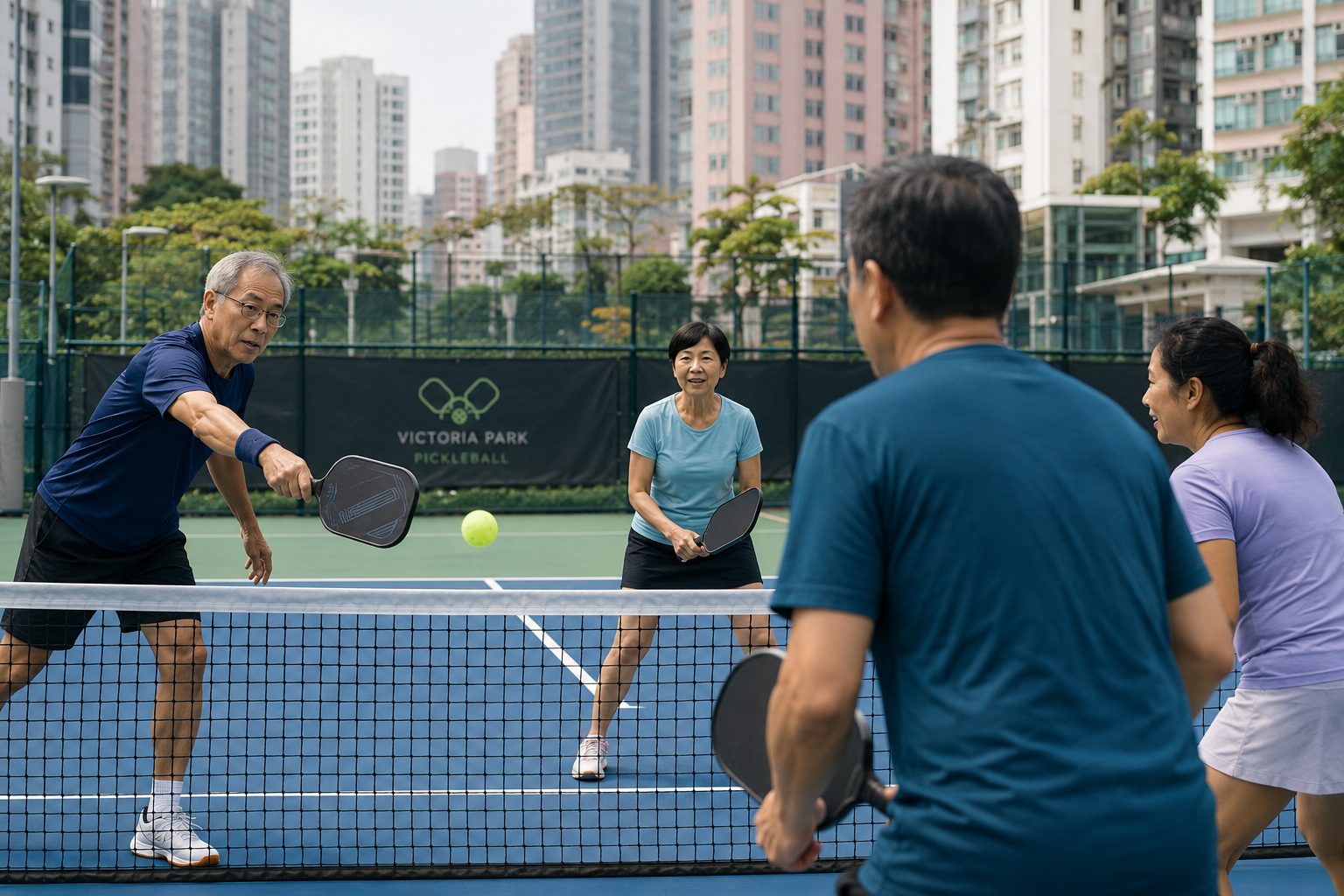
Can pickleball reverse ageing? No, but a new randomized trial from Hong Kong found something that deserves attention.
After eight weeks of supervised pickleball, 42% of older adults who began the study with pre-frailty no longer met the pre-frailty criteria. In the control group, the figure was just 8%.
That does not mean pickleball made anyone biologically younger. It does suggest that regular play may improve some of the physical abilities that become increasingly important as we age.
First, what does "pre-frail" actually mean?
Frailty is not simply another word for being old. It describes a decline in physical reserve, which can leave someone with less capacity to recover from a fall, illness, hospital stay or other stress on the body.
Pre-frailty is the earlier warning stage. Someone may show one or two signs such as:
- Reduced strength
- Slower walking
- Low physical activity
- Exhaustion
- Unintentional weight loss
A person with pre-frailty is not necessarily frail, but their physical reserve may be starting to decline. That makes this stage particularly interesting to researchers because there may still be an opportunity to improve it.
What the Hong Kong researchers did
The 2026 randomized controlled trial followed 72 community-dwelling older adults with pre-frailty, with a median age of 67. Researchers randomly assigned them to either a pickleball programme or a control group.
The pickleball group completed:
- One-hour supervised sessions
- Two sessions per week
- Eight weeks of play
The control group continued its usual lifestyle. Because participants were randomly assigned, the study provides stronger evidence than a survey of people who already choose to play pickleball.
The headline result: 42% moved out of pre-frailty
After eight weeks:
- 15 of 36 participants in the pickleball group moved to non-frail status
- 3 of 36 participants in the control group moved to non-frail status
That works out to roughly 42% versus 8%.
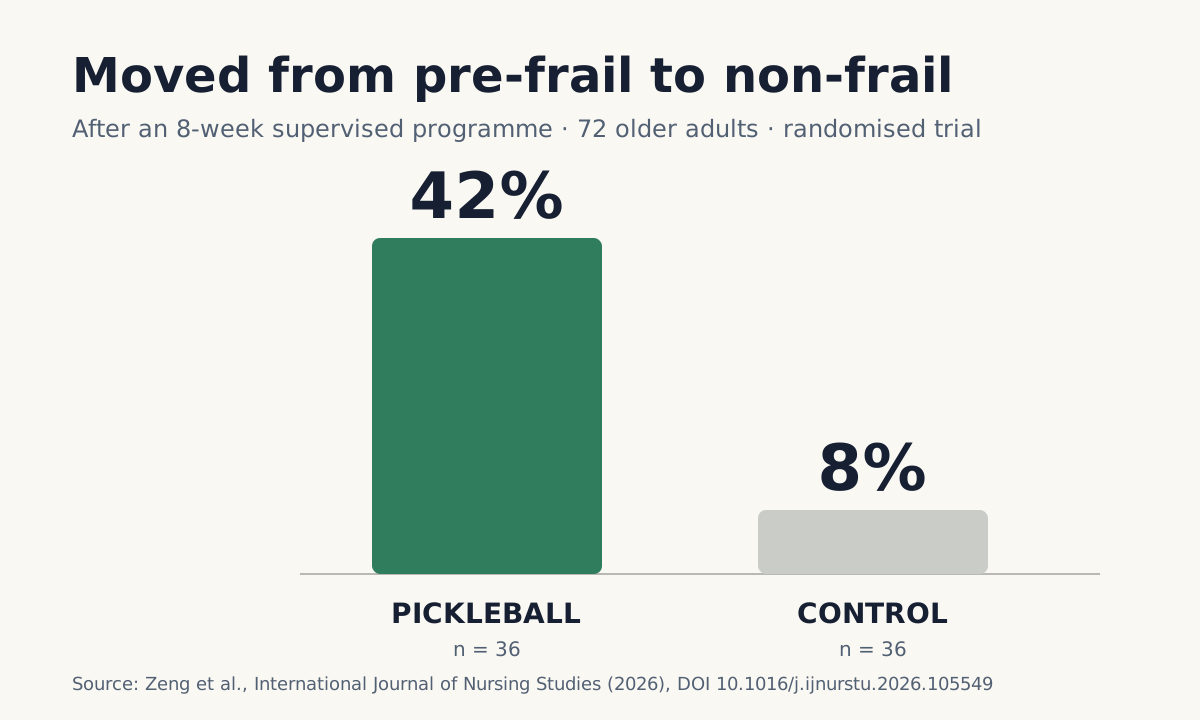
This is the finding most likely to generate headlines, but it needs to be interpreted carefully. Moving from pre-frail to non-frail does not mean ageing reversed. It means that when researchers assessed the physical criteria again, those participants no longer crossed the study's threshold for pre-frailty.
That is still meaningful. If declining strength, activity and mobility can be improved before someone progresses further towards frailty, it could have important implications for healthy ageing.
It was not just the frailty score
The pickleball group also improved across several measures of physical function. Researchers reported improvements in:
- Chair stands
- Arm curls
- Flexibility
- Six-minute walking distance
- Light physical activity
- Sedentary time
- Physical quality of life
- Mental quality of life
Many of these tests reflect abilities people use outside a sports setting. Getting out of a chair, walking for longer periods and maintaining strength are practical markers of independence as people age.
Pickleball also makes the body react
There may be another reason pickleball is interesting for older adults. Walking or cycling usually involves relatively predictable movement, while pickleball asks players to respond to a constantly changing situation.
The ball changes direction, opponents move, and players have to track the shot, adjust their feet and decide what to do next. That makes pickleball an open-skill sport, where movement and decision-making happen together.
A second 2026 Hong Kong randomized trial looked more closely at this. After eight weeks, pre-frail older adults who played pickleball showed improved adaptability in how their hips, knees and ankles coordinated while walking under simultaneous physical or mental demands.
Not every walking measurement improved. Cadence, stride length and stepping strategy did not show clear changes, so the study does not prove that pickleball prevents falls. It does provide an interesting signal that the sport may challenge coordination in ways that go beyond simply raising your heart rate.
A small 2025 randomized trial involving 36 women aged 60 to 75 also reported improvements in balance, walking speed, cadence, stride length and social capital after eight weeks of supervised play. The findings are promising, but the sample was small and needs replication.
What Apple learned from 250,000 workouts
The Apple Heart and Movement Study offers a very different kind of evidence.
Apple, Brigham and Women's Hospital, and the American Heart Association analysed more than 250,000 pickleball and tennis workouts recorded on Apple Watch. Instead of placing people into a controlled programme, the researchers looked at what players did in real life.
Pickleball sessions lasted 90 minutes on average, compared with 81 minutes for tennis. The average peak heart rate was 143 beats per minute for pickleball and 152 for tennis. Across both sports, participants reached an average peak within 70% of their estimated maximum heart rate.
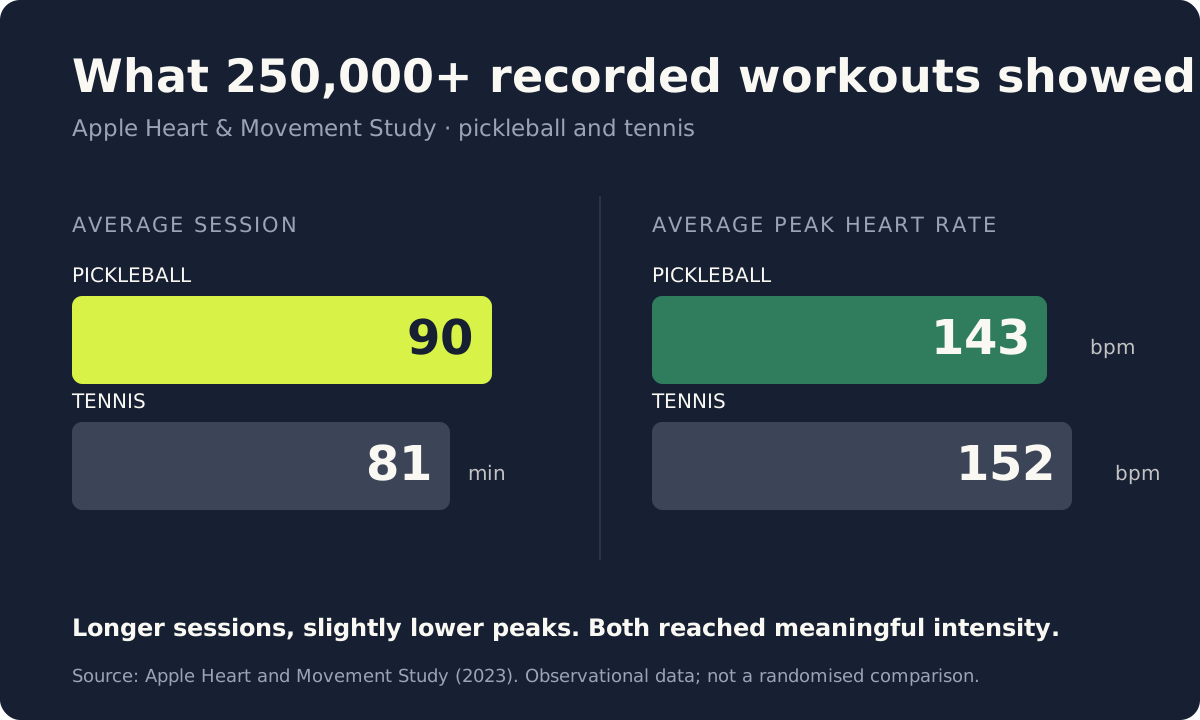
This does not show that pickleball is more effective than tennis. It shows that pickleball is not automatically a gentle, barely active pastime. Real players often stay on court for a long session and reach meaningful heart-rate peaks.
Apple also found that frequent pickleball players had lower odds of a short depression screen suggesting depressed mood than the study pool overall. That is an association, not proof that pickleball caused the difference. Frequent players may differ from the wider group in health, income, social connection and many other ways.
So, does pickleball count as cardio?
For many recreational players, yes.
In a small 2023 study, 33 players aged 65 and older wore activity monitors for two weeks. A playing session produced more than 68 minutes of moderate-to-vigorous physical activity on average. Play days also included more steps and less sedentary time.
Another small study compared 30 minutes of doubles pickleball with 30 minutes of self-paced walking. Pickleball produced a 14% higher average heart rate and 36% more energy expenditure. Players also rated it as far more enjoyable. Walking, however, produced more total steps.
That last point is useful. Exercise does not need a single winner. Walking is easy to access and easy to control. Pickleball adds short bursts, lateral movement and rapid decisions. The intensity changes with rally length, skill level, singles versus doubles, and how much time is spent waiting between games.
A simple check is the talk test. At moderate intensity, you can speak in sentences but singing would be difficult. If you can chat effortlessly through every point, the session may be light activity. If you are gasping, you may be working at a vigorous level.
The mental benefit may happen between the points
The most interesting health feature of pickleball may be the part that does not look like exercise.
A 2025 survey of 1,667 US players used the WHO-5 Wellbeing Index, a five-question measure of how often someone has recently felt cheerful, calm, active, rested and interested in daily life. Higher scores indicate better subjective wellbeing.
People who played at least three times a week reported higher WHO-5 scores than those who played no more than twice. Longer sessions were also associated with higher scores. The relationship was especially noticeable among older players.
Another national survey of 825 adults over 50 found that current players reported less loneliness and social isolation than people who had never played or had stopped.
Neither survey proves cause and effect. People who feel better may be more likely to play. Health, free time and an existing social circle may influence both participation and wellbeing.
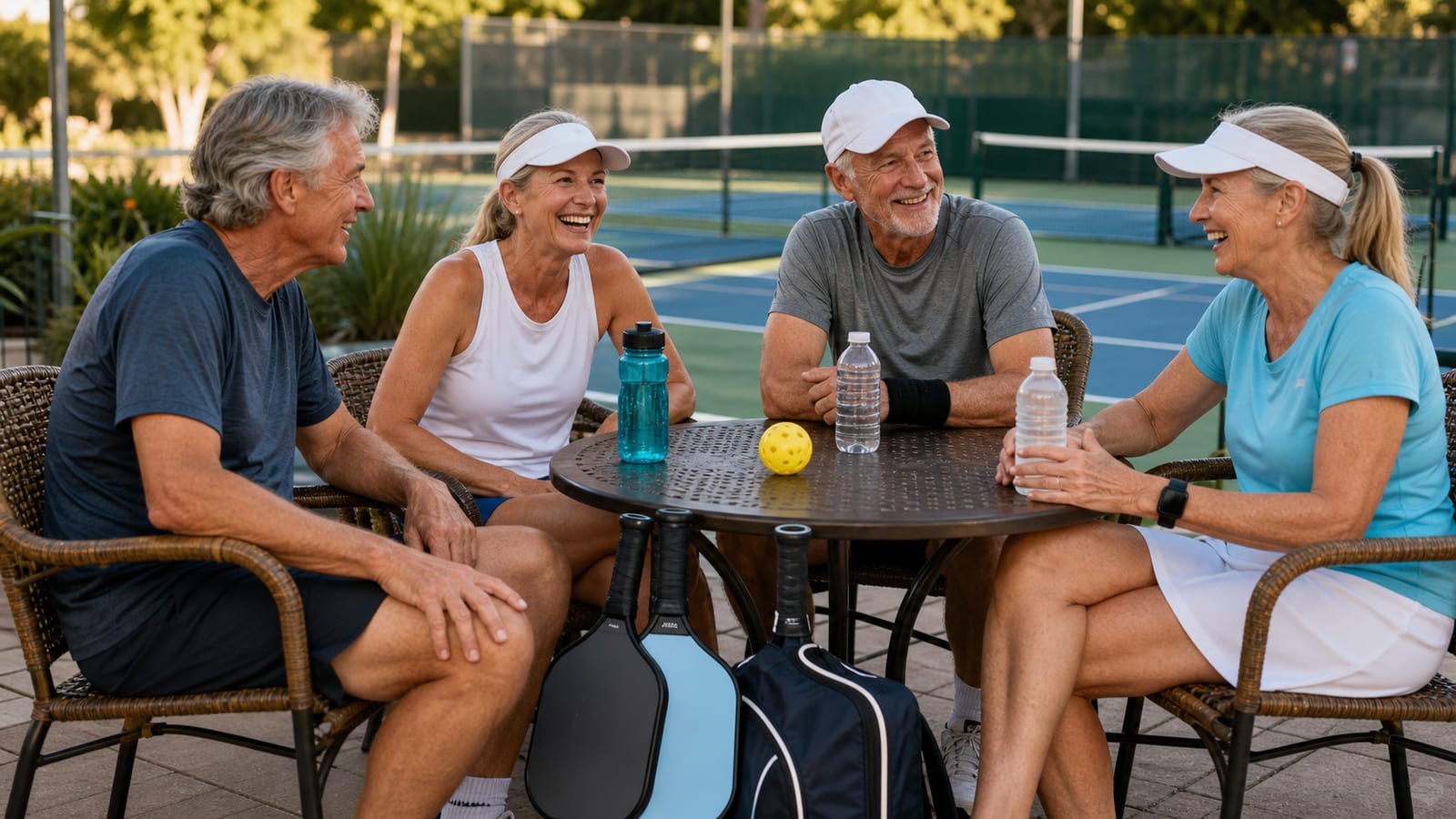
The pattern still makes intuitive sense. Doubles creates repeated contact. A stranger becomes a partner. A booking becomes a routine. A court becomes a place where people expect to see you again.
Why pickleball may work particularly well
The “best” exercise on paper is not much use if you dread it and stop after two weeks.
Pickleball packages four things into the same hour:
- Cardio: steady movement and short bursts raise your heart rate.
- Coordination: shuffling, reaching, stopping and reacting challenge the body.
- Attention: every rally asks you to read space and make quick decisions.
- Connection: partners, opponents and open play create a reason to return.
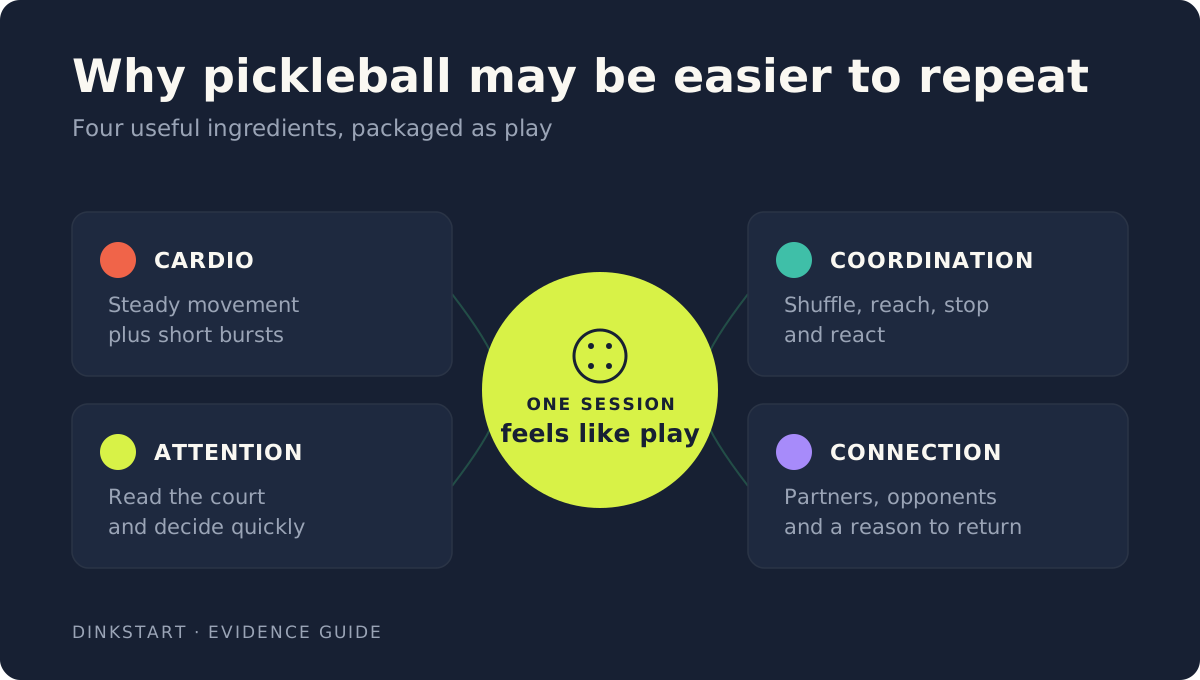
This combination is the most convincing explanation for pickleball's appeal. It feels like a game, but it quietly accumulates movement, practice and contact with other people.
What the study does not prove
The result is encouraging, but it comes with important limits:
- The trial involved only 72 people
- It lasted eight weeks
- Participants were older adults who already had pre-frailty
- The pickleball programme was supervised
We cannot assume the same result would occur in younger adults, frail adults, completely sedentary people or someone casually playing once every few weeks. We also do not yet know whether the improvements persist for years. Larger and longer studies are needed.
Should older adults start playing pickleball?
For many people, pickleball can be a practical way to add movement, coordination and social activity to the week. But the smaller court should not be mistaken for zero physical risk. The sport still involves quick stops, lateral movement and sudden reactions.
Quick changes of direction can strain ankles, knees and calves. Repeated swings can irritate the elbow or shoulder. Falls can cause wrist fractures. Eye injuries are uncommon but can be serious.
The biggest risk for many new players is enthusiasm rising faster than conditioning. Going from little exercise to several long sessions each week asks muscles and tendons to absorb a workload they have not built up to.
To make the habit more sustainable:
- Warm up with dynamic movement before the first game.
- Wear court shoes that support lateral movement.
- Increase playing time and weekly frequency gradually.
- Add basic strength work for calves, hips, legs, shoulders and forearms.
- Consider impact-rated protective sports eyewear.
- Stop for sharp pain, chest pain, dizziness or unusual breathlessness.
- Speak with a clinician before starting if you have a heart or lung condition, or if you are returning after a long inactive period.
The aim is not to become so cautious that you never play. It is to stay healthy enough to keep playing.
The verdict
So, is pickleball good for you?
The current evidence supports a measured yes.
The Hong Kong research does not show that pickleball reverses ageing. It shows something more credible: in a randomized trial of older adults with pre-frailty, supervised pickleball twice a week for eight weeks improved frailty status and several measures of physical function.
But the research base is still young. Many studies are small, short or focused on older adults. Surveys cannot prove cause and effect. Injury prevention is part of the health story, not an afterthought.
The paddle is not magic. The useful part is the combination: move, react, learn, connect, then enjoy it enough to come back.
Sources
- Effects of pickleball on pre-frailty, physical fitness, 24-hour movement behaviours and quality of life in older adults, International Journal of Nursing Studies, 2026.
- Apple Heart and Movement Study pickleball findings, Apple, Brigham and Women's Hospital, and the American Heart Association, 2023.
- Eight-week pickleball intervention and dual-task gait performance, Experimental Gerontology, 2026.
- Pickleball exercise, physical performance and social capital in older women, Journal of Aging and Physical Activity, 2025.
- Pickleball participation and mental wellbeing in US adults, Frontiers in Psychology, 2025.
- Pickleball participation, loneliness and social isolation, Journal of Primary Care & Community Health, 2025.
- Physical activity from pickleball in older adults, Recreational Sports Journal, 2023.
- Doubles pickleball compared with self-paced walking, Science & Sports, 2022.
- Pickleball eye injuries in US emergency departments, JAMA Ophthalmology, 2025.
This article is general information, not medical advice. Individual health conditions and exercise needs vary.